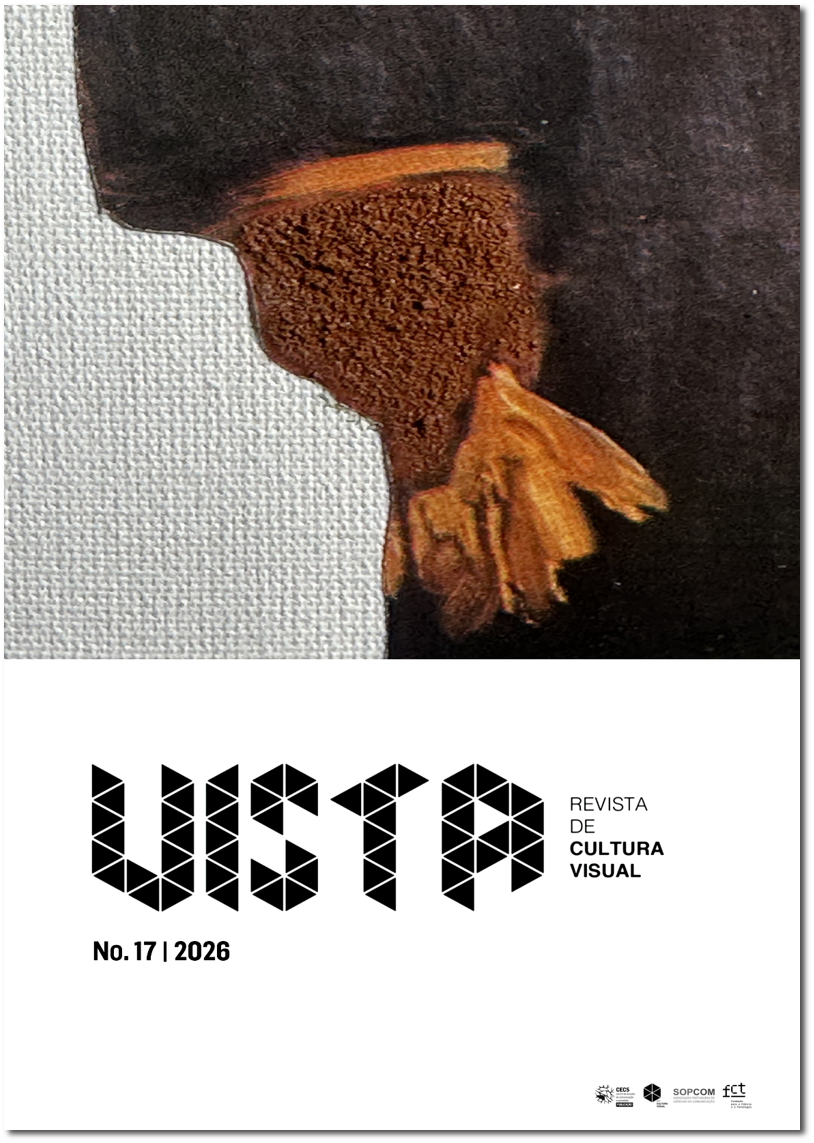
Introductory Note: Constellations of the Sensible, Aesthesis and Cultural Frictions
DOI:
https://doi.org/10.21814/vista.7506Downloads
References
Bourdieu, P. (2001). O poder simbólico (F. Tomaz, Trad.). Difel. (Trabalho original publicado em 1989)
Brah, A. (2005). Cartographies of diaspora: Contesting identities. Routledge.
Cabecinhas, R. (2025). Fronteiras, memória e (in)atenção na era da plataformização. In A. Esteves, B. Madeira, F. M. Ferreira, F. Bessa Ribeiro & J. Alves (Eds.), Guerras e paz. Riscos, dinâmicas e horizontes de futuro (pp. 77–87). Universidade do Minho.
Danto, A. C. (2014). After the end of art: Contemporary art and the pale of history. Princeton University Press. (Trabalho original publicado em 1997)
Deleuze, G. (1997). Crítica e clínica (P. P. Pelbart, Trad.). Editora 34. (Trabalho original publicado em 1993)
Freeland, C. (2012). Aesthetics and the senses: Introduction. Essays in Philosophy, 13(2), 399–403. https://doi.org/10.7710/1526-0569.1427
Hegel, G. W. F. (2003). Lecciones sobre la estética (H. G. de los Ríos, Trad.). Mestas Ediciones. (Trabalho original publicado em 1834)
Kant, I. (2017). Crítica da faculdade do juízo (A. Marques & V. Rohden, Trads.). Imprensa Nacional Casa da Moeda. (Trabalho original publicado em 1970)
Krenak, A. (2019). Ideias para adiar o fim do mundo. Schwarcz.
Krenak, A. (2020). Radicalmente vivos. O Lugar.
Martins, M. de L. (2011). Crise no castelo da cultura: Das estrelas para os ecrãs. Edições Húmus.
Mbembe, A. (2001). As formas africanas de auto-inscrição. Estudos Afro-Asiáticos, 23(1), 171–209. https://doi.org/10.1590/S0101-546X2001000100007
Mignolo, W. (2010). Aiesthesis decolonial. Calle 14: Revista de Investigación en el Campo del Arte, 4(4), 10–25. https://doi.org/10.14483/21450706.1224
Mignolo, W. (2019). Reconstitución epistémica/estética: La aesthesis decolonial una década después. Calle 14: Revista de Investigación en el Campo del Arte, 14(25), 14–33. https://doi.org/10.14483/21450706.14132
Mombaça, J., & Mattiuzzi, M. M. (2023). Carta à leitora preta do fim dos tempos. In D. F. da Silva (Ed.), A dívida impagável (pp. 15–27). Zahar.
Ostrower, F. (2022). Criatividade e processos de criação. Vozes. (Trabalho original publicado em 1977)
Paiva, A. S. (2022). A virada decolonial na arte brasileira. Mireveja.
Pereira, A. C. (2026). O movimento negro em Portugal e a Greenhouse: Pavilhão de Portugal na Bienal de Veneza 2024. In R. Cabecinhas, I. Macedo, & L. Lins (Eds.), Living memories & media/Memória viva & media (pp. 55–73). Edições Húmus.
Posch, P. (2024). Migration and contemporary visual art: Exploring intersections and possibilities. In I. Sirkeci (Ed.), The migration conference 2024 selected papers (pp. 181–185). Transnational Press London.
Rancière, J. (2009). A partilha do sensível (M. C. Netro, Trad.). Editora 34. (Trabalho original publicado em 2000)
Rolnik, S. (2018). Esferas da insurreição: Notas para um vida não cafetinada. N1 Edições.
Santos, M. P. dos. (2024). Desaprender o que é a história da arte. In M. P. dos Santos & M. Mestre (Eds.), Problemas do primitivismo – A partir de Portugal (pp. 17–21). Oficina CIPRL/CIAJG.
Vázquez Melken, R. (2020). Vistas of modernity: Decolonial aesthesis and the end of the contemporary. Mondriaan Fund.
Downloads
Published
Issue
Section
License
Copyright (c) 2026 Patricia Posch, Alessandra Simões Paiva, Rosa Cabecinhas

This work is licensed under a Creative Commons Attribution 4.0 International License.
Authors own the copyright, providing the journal with the right of first publication. The work is licensed under a Creative Commons Attribution 4.0 International License.